Photoelectrochemical (PEC) system is an important system that uses photoelectrodes to realize photo-electric-chemical energy conversion. Because of its potential application value in energy conversion, environmental detection, molecular recognition and other fields, it has become a research hotspot in the field of material chemistry and energy chemistry. Compared with the traditional electrochemical system, the PEC system has the advantages of high energy conversion efficiency and mild reaction conditions by means of light-enhanced charge transfer effect, which can efficiently drive various redox reactions. However, the photoelectrode of the current PEC system generally has the problem of insufficient selectivity. The anode is easy to induce the simultaneous oxidation of a variety of reducing agent molecules, and it is difficult to achieve the specific recognition and transformation of the target molecules, which brings great challenges to its practical application in precise detection, efficient catalysis and other scenarios.
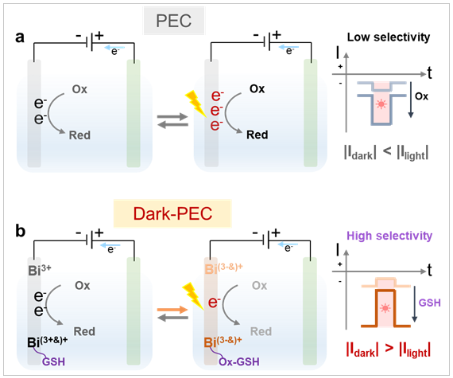
In view of this, the research groups of Professor Liuyong Hu at Wuhan Institute of Technology and Professor Chengzhou Zhu at Central China Normal University have collaborated to make new progress in the selectivity regulation and mechanism innovation of PEC systems. The team designed and constructed a dark-enhanced photoelectrochemical (dark-PEC) system based on a bismuth oxybromide (BiOBr) photocathode, breaking through the inherent light-enhancement mode of traditional PEC systems. By exploiting the reversible reduction properties of bismuth, they achieved passivation and regeneration of the oxygen reduction sites on the photocathode, and successfully obtained an unconventional reversed photocurrent signal with |Idark| > |Ilight|. Through the selective binding and charge transfer between glutathione and BiOBr, the reversibility of bismuth reduction was significantly enhanced, amplifying the reversed photocurrent by 10 times and enabling selective recognition of reductant molecules by the photocathode. This study reveals a completely new photoelectrochemical reaction mechanism, effectively solving the long-standing problem of insufficient selectivity in traditional PEC systems, significantly expanding the application scenarios of PEC systems, and providing an important reference for device design and redox process studies in this field.