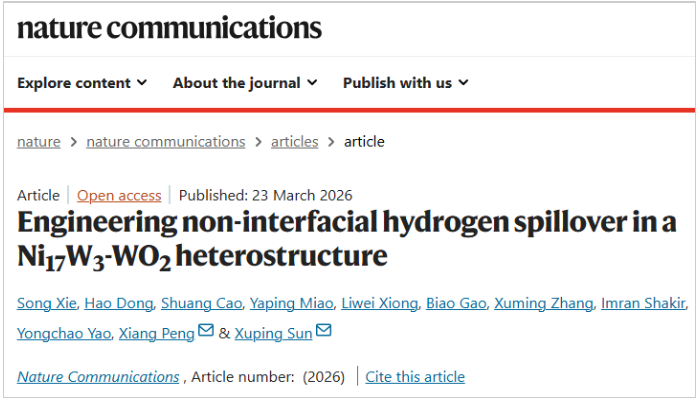
(Correspondent: Liu Husen) Recently, the research team led by Professors Xiong Liwei and Peng Xiang from the School of Materials Science and Engineering has made significant progress in the field of hydrogen catalysis. The related findings have been published in the internationally renowned journal Nature Communications (IF: 15.7) under the title "Engineering non-interfacial hydrogen spillover in a Ni₁₇W₃-WO₂ heterostructure." The study proposes a universal design strategy of strain gradient engineering and successfully achieves efficient "non-interfacial hydrogen spillover" in a non-noble metal heterostructure catalyst, opening a new avenue for the rational design of low-cost, high-performance electrocatalysts. Xie Song, a doctoral student at the School of Materials, is the first author of the paper, Peng Xiang and Professor Sun Xuping from Sichuan University are the corresponding authors, and Professor Xiong Liwei is a co-author. Our university is the first affiliation of the paper.
Blazing a new trail to overcome the interface dilemma
As the global demand for sustainable energy becomes increasingly urgent, green hydrogen has emerged as a key vehicle for achieving carbon neutrality goals. Proton exchange membrane water electrolysis for hydrogen production has attracted considerable attention owing to its high efficiency and fast response. However, this technology is heavily dependent on scarce and expensive platinum-group metal catalysts, severely hindering its large-scale industrial application. Although non‑noble metal catalysts are low in cost, they generally suffer from an insurmountable "hydrogen adsorption–desorption" paradox: they bind hydrogen too strongly, making it difficult for the product hydrogen to desorb and thus resulting in sluggish reaction kinetics. The hydrogen spillover effect has been regarded as an effective strategy to overcome this bottleneck, yet the conventional spillover mechanism relies on hydrogen atoms migrating across the interface between different phases, where the electronic barriers and structural instability present at the interface constantly restrict the improvement of catalytic efficiency.
To address the above challenges, the research team proposed a completely new design concept: constructing an efficient hydrogen migration channel within a single phase to completely circumvent the interfacial transport bottleneck. Using an in situ phase reconstruction method, the team successfully constructed a heterostructure catalyst composed of a Ni₁₇W₃ alloy phase and a WO₂ oxide phase.
The study reveals that the heterointerface lattice mismatch generates a continuously varying strain field within the Ni₁₇W₃ phase, providing an internal driving force for the directional migration of hydrogen atoms. Meanwhile, directional electron transfer from Ni₁₇W₃ to WO₂ at the interface precisely optimizes the hydrogen adsorption energy of the active sites. Through the synergistic effect of these two mechanisms, the adsorption, migration, and desorption of hydrogen atoms are entirely confined within the single Ni₁₇W₃ phase, forming a hydrogen migration pathway that does not cross the interface, thereby fundamentally circumventing the interfacial energy losses inherent in conventional heterostructure catalysts.
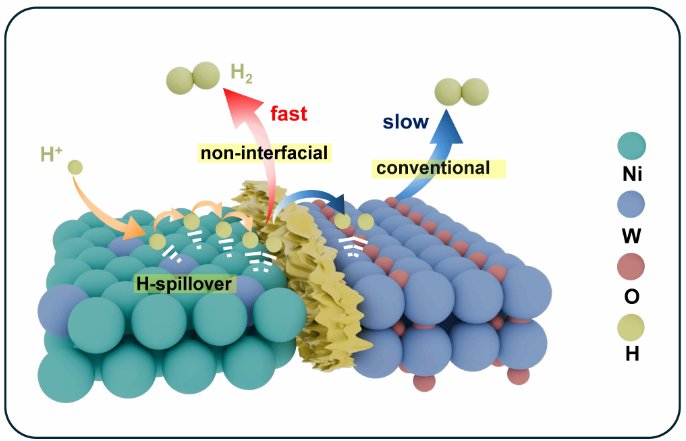
The research team verified this mechanism through multiple characterization methods, including in situ Raman spectroscopy and kinetic isotope effect measurements. Notably, in situ Raman spectroscopy directly captured the dynamic process of hydrogen atom migration within the Ni₁₇W₃ phase, providing solid experimental evidence for the proposed mechanism. In a full proton exchange membrane electrolyzer cell, the Ni₁₇W₃–WO₂ catalyst exhibited performance comparable to that of commercial platinum-on-carbon catalysts, demonstrating continuous and stable operation for over 1500 hours at an industrial current density of 500 mA cm⁻², and showing promising prospects for industrial application.
The team further extended this design strategy to the Co–W alloy system and successfully synthesized a Co₀.₈₇W₀.₁₃–WO₂ heterostructure. This material also exhibited the key kinetic characteristics of non‑interfacial hydrogen migration, validating the universality of strain gradient engineering as a general design principle.
Ten Years of Perseverance: WITer Rises from Undergraduate to First Author in a Top Journal
Xie Song, the first author of the paper, is a homegrown bachelor's–master's–doctoral student of Wuhan Institute of Technology. Under the supervision of Professors Xiong Liwei and Peng Xiang, he has long focused on the surface and interface regulation of electrocatalysts and reaction mechanism studies. During his time at the university, he has published multiple papers as the first author in well-known journals in the field of energy materials chemistry, including Applied Catalysis B: Environment and Energy (IF: 21.1) and Coordination Chemistry Reviews (IF: 23.5). The research findings published in Nature Communications this time represent another important breakthrough in his doctoral research.
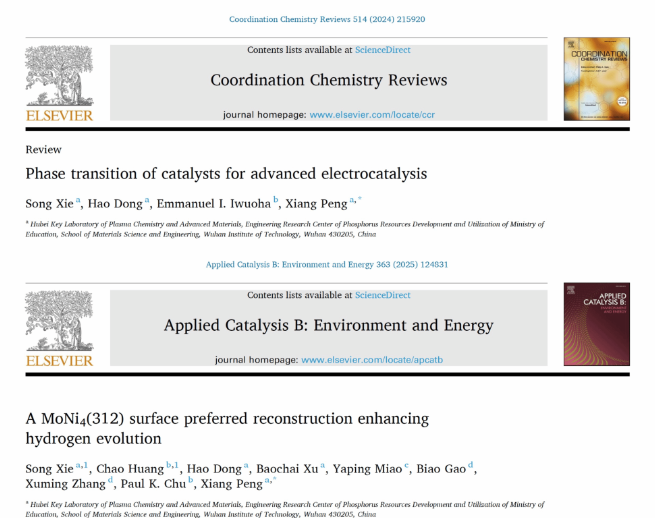
From laying a solid foundation during his undergraduate years to consistently producing high-level research output in internationally renowned journals during his doctoral studies, Xie Song's growth trajectory epitomizes the university's cultivation of top-tier innovative talents.
Accumulating for a Breakthrough: Deep Cultivation in Non‑Noble Metal Catalysis
This breakthrough published in Nature Communications is one of the results of the team's long-term deep cultivation in the field of non‑noble metal electrocatalysis. In recent years, the team has focused on the surface/interface regulation and reaction mechanism studies of non‑noble metal electrocatalysts, achieving a series of innovative achievements in hydrogen energy catalysis, with multiple works selected as ESI Highly Cited Papers and Hot Papers.
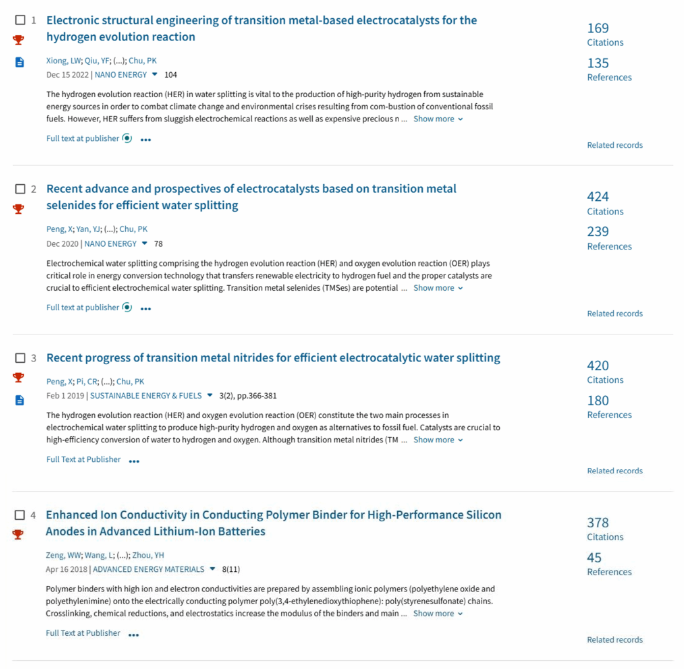
Using molybdenum-based catalysts as a model system, the team exploited the work function difference at the interface to construct a built-in electric field, which significantly enhanced the hydrogen evolution performance and enabled stable operation at ampere-level current density for 240 hours (Science China Materials, a journal in the Science China series). By constructing a molybdenum-based heterostructure through a one-step carbonization/nitridation method, they achieved efficient hydrogen evolution over a wide pH range and in real seawater, demonstrating excellent potential for universal application (Chemical Engineering Journal, IF: 13.2). They designed and prepared a Co–Fe-based heterostructure catalyst, achieving stable operation at a current density of 2 A cm⁻² for 240 hours in alkaline media (Science China Technological Sciences, a journal in the Science China series). They systematically reviewed the latest advances in coupled electrocatalytic hydrogen production strategies, exploring new pathways to reduce electrolysis energy consumption, such as urea/hydrazine hydrate oxidation, value-added electrosynthesis of small molecules, and waste upcycling, providing a comprehensive theoretical framework for the development of energy-saving hydrogen production technologies (Materials Science and Engineering: R: Reports, IF: 26.8). For all the above achievements, Wuhan Institute of Technology is the first affiliation.
These prior accumulations have laid an important foundation for the proposal of the "non‑interfacial hydrogen spillover" strategy in this work. While making continuous breakthroughs in fundamental research, the team also attaches great importance to technology protection, having been granted over 20 invention patents and utility model patents, thus forming a cluster of core technologies with independent intellectual property rights. In recognition of his sustained contributions in the field of electrocatalysis, Professor Peng Xiang has been listed among the World's Top 2% Scientists for 2023–2025.
Going forward, the team will further focus on the key scientific issues in the field of electrocatalytic hydrogen production, accelerate the translation of fundamental research achievements into practical applications, and continue to serve the major needs of the national energy strategy and green, low-carbon development.
Research-Integrated Education: Bearing Abundant Fruit in Talent Cultivation
What matters more than publishing high-level papers is nurturing talents who can consistently produce high-level achievements. Among the four cohorts of students Professor Peng Xiang has supervised to graduation, more than ten have won the National Scholarship under his guidance, and the dissertations of four students have been recognized as university-level Outstanding Master's Theses. He not only delves deeply into scientific research but also places great emphasis on pedagogical research, having published three teaching research papers in the Journal of Chemical Education, a well-known journal in the field of chemical education, integrating cutting-edge research into classroom teaching.
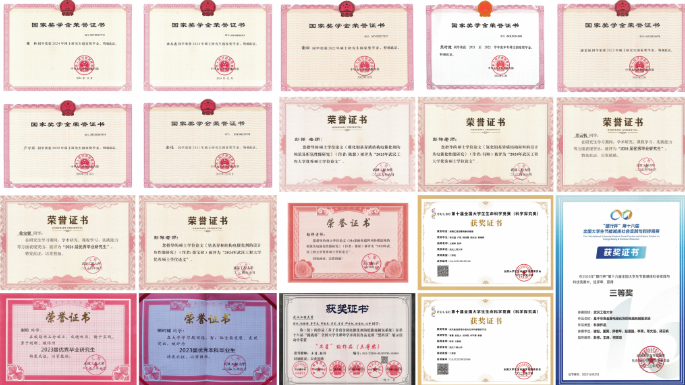
Under the guidance of Professor Peng Xiang, graduate student Xie Song won the Third Prize in the "Black Technology" Special Competition of the "Challenge Cup" National Undergraduate Extracurricular Academic Science and Technology Contest, as well as the Third Prize in the National Undergraduate Energy Conservation and Emission Reduction Social Practice and Science and Technology Contest, with the project "Low-energy-consumption Hydrogen Production System Based on Non‑Noble Metal Electrocatalysts." He also supervised undergraduate students Li Xinrui and Cao Shuang, who respectively won the Third Prize in the National Undergraduate Life Science Competition.